What Is the Typical Cost of Precast Concrete Stairs in Costa Mesa?
Precast steps can be a quick, tidy way to rebuild an entry, but the unit itself is only part of what you pay for.
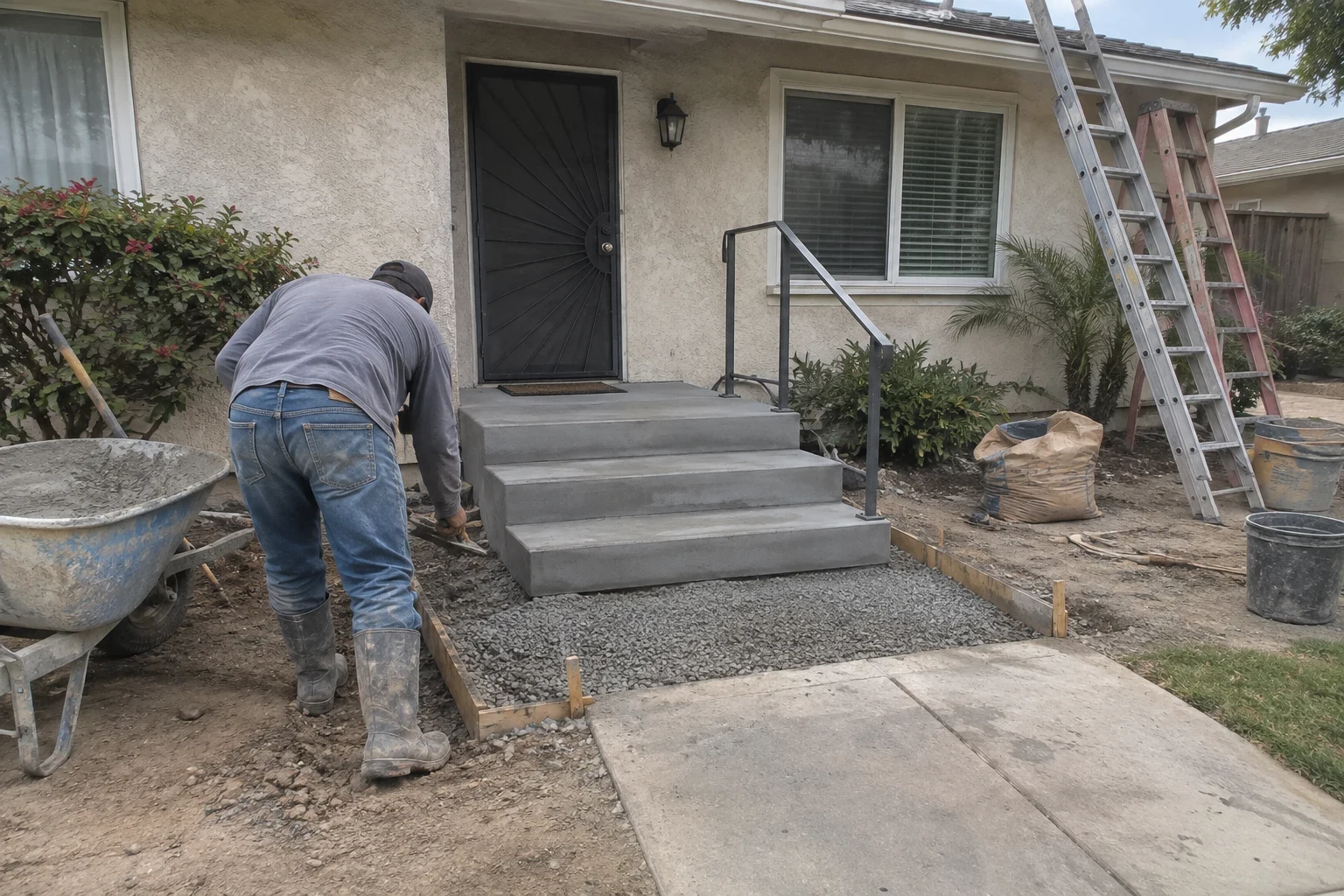
What is the typical cost of precast concrete stairs?
There is no single typical price for precast concrete stairs, because the cost depends on how many steps you need, their width, how the unit gets delivered and set, and the prep and removal work around it. A fair number comes after someone measures your entry and looks at access. Talk it through with us at (949) 841-4109.
What drives the cost of precast concrete stairs
A precast stair is cast in a plant, cured, then trucked to your home and set in place in one piece. That means the price is shaped as much by the trip and the setting as by the concrete. A three-step unit at a front door with open driveway access is a very different job from a five-step unit that has to reach a back slider through a narrow side yard.
Here is what usually moves the number up or down, roughly in order of how much it matters.
- Number of risers and overall width. More steps and wider treads mean a heavier unit, more material and bigger equipment to lift it.
- Standard size or custom. Units that match common rise and width dimensions cost less than ones cast to an unusual height.
- Access for delivery. A boom truck or machine needs a clear path and a solid spot to work from; overhead lines, trees, gates and tight side yards add time and labor.
- Removing the old steps. Breaking out and hauling away existing concrete, brick or wood is its own line item.
- Base preparation. Precast steps need a compacted gravel base or footing that is level and firm, and soft or uneven soil takes more work.
- Railings and finish details. Handrails, a landing, or matching the surrounding walkway all add to the total.
Precast or poured in place: which costs less for your entry
Neither is always cheaper. Precast tends to win on simple, standard entries where a truck can get close, because there is no forming, no rebar layout on site and no waiting for a pour to cure before you can use the door. Poured-in-place steps tend to make more sense when the height is unusual, the stair needs to turn or wrap a corner, or there is no way to get a heavy unit to the spot.
Poured steps also give you more choices for looks. We can match a broom finish, color or stamped pattern to a new patio or walkway, while most precast units come in plain gray with a light texture. If the stairs connect to other concrete work you are planning, pouring everything together can keep the finish consistent and save a separate mobilization.
When you call, we will ask about the height from grade to your door threshold, the width you want and how a truck would reach the spot. That is usually enough to tell you which route fits your entry before anyone comes out to measure.
Costs that are easy to miss before you commit
The quote for the stair unit is rarely the whole picture. Ask about these items up front so the final number holds steady.
California's residential code sets limits on riser height and tread depth, and a stair with four or more risers generally needs a handrail. A precast unit has to land your door threshold at the right height, so if the existing landing or porch is off, it may need adjusting first. Whether a permit is needed depends on the project and the city's current rules; we will tell you what applies to your stairs and handle that step if it is required.
- Demolition and haul-off of the old steps
- Patching the walkway or slab where the new unit meets it
- Handrail supply and installation
- Any landing or porch work needed to meet the door at the right height
- Permit fees, if the project requires one
- Landscape or irrigation adjustments around the new footprint
How timing and scheduling affect the job
Most of the time on a precast job happens before delivery day. The unit has to be ordered to size, and the old steps need to come out and the base needs to be prepped so the new stair sits level the moment it arrives. Setting the unit itself is often a short visit once everything is ready.
We give you a realistic window for each stage: when demo happens, when the base goes in and when the truck is coming. If a delivery slips or a crew gets held up, we call you with the new time instead of leaving you waiting at the window. That matters on a stair job, because your entry may be out of use between removal and setting, and you need to know which door to use and for how long.
Our mild coastal weather in Costa Mesa means rain delays are uncommon for most of the year, but winter storms do happen. If one would soften the base or make a lift unsafe, we will move the date and tell you as soon as we know.
More questions about precast stairs
Can precast steps be set against an existing porch or slab?
Usually yes, as long as the porch is sound and the unit can be sized to meet the threshold at a code-compliant height. We check the height and the condition of the landing before recommending it.
Do precast concrete stairs need a footing?
They need a firm, level, well-compacted base under the full footprint. Depending on the size of the unit and the soil, that may be a gravel pad or a small concrete footing, and we will explain which one your stairs need and why.
Can precast stairs be colored or stamped to match my patio?
Options are limited with most precast units. If a matching color or stamped finish matters to you, poured-in-place steps are usually the better fit, and we can walk you through that comparison on the phone.
How long until I can use the new steps?
Precast steps arrive fully cured, so you can generally walk on them soon after they are set and any patching around them has firmed up. We will tell you exactly when your entry is ready to use.
Find out what your stairs will take
Call and tell us about your entry: how many steps, how wide and how a truck would get there. We will tell you whether precast or poured steps fit better, what goes into the price, and give you a realistic timeline you can plan around. Get your quote by phone.