ServicesConcrete Garage Floors
Concrete Garage Floors in Costa Mesa
We tear out tired garage slabs and pour new ones that drain toward the door and hold up to daily parking. Before we start, you get a day-by-day plan covering demolition, pour and cure, so you know when to clear the garage and when to park again.
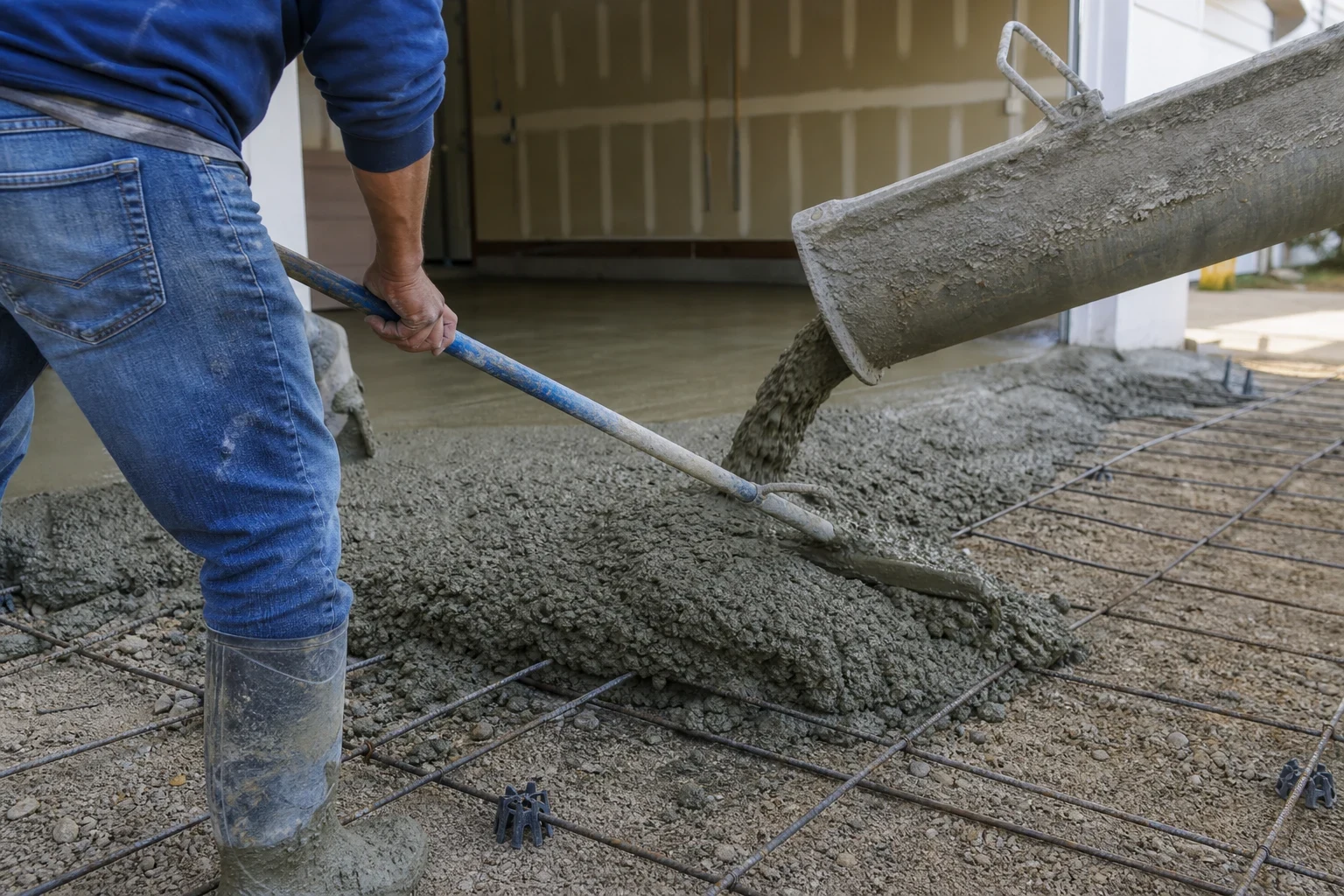
A new garage floor, planned around your car and your calendar
A garage floor takes more weight than any other slab at your home. It carries a parked vehicle every night, hot tires, dripping oil and the occasional dropped tool. When the old slab has sunk, heaved or broken into loose pieces, patching rarely lasts. Removing it and pouring new concrete on a properly prepared base is the lasting fix.
The hard part for most people is how long it takes, not the concrete. Your car needs somewhere else to live for about a week, and everything stored in the garage has to move. So we start with the schedule. You get realistic dates for each stage, an arrival window on work days, and a call from us if weather or a concrete delivery shifts the plan.
What the work includes
Removal and haul-off
We saw-cut along the edges of the old slab so the walls and footing aren't disturbed, then break it up and load every chunk onto our truck. The broken concrete leaves with us the same day, so your driveway stays clear.
Base preparation
We grade and compact the soil underneath, then spread a layer of fresh base rock on top. A lot of the ground under older Costa Mesa homes is clay that swells when wet and shrinks when dry, and a firm, compacted base keeps the new floor from shifting along with it.
Moisture barrier and reinforcement
When the site calls for it, we put down a vapor barrier to slow moisture rising from the ground. Rebar or wire mesh is set up on supports so it ends up in the middle of the concrete rather than lying on the dirt.
Slope to the door and control joints
We set the forms with a gentle fall from the back wall toward the door, so water off a wet car or a rinse runs outside rather than pooling. We also cut joints into the fresh slab, which gives the small cracks every pour develops a straight, planned line to follow.
A finish matched to how you use the space
Most garages get a smooth steel-trowel finish that is easy to sweep. If you're thinking about a coating down the road, mention it before pour day and we will leave the surface ready for it.
Signs it's time for a new garage floor
Sections that have sunk or lifted
When one slab section sits lower than the next, tires bump over it and water collects at the low edge. It usually means the ground underneath has settled or washed out.
Wide, spreading cracks
Thin surface lines are expected in any slab. The worry is a gap wide enough to slip a coin into, or a crack that gets longer and moves from season to season, because that tells us the ground below is no longer holding the slab up.
Flaking, crumbling surface
Years of oil, salt from cars driven in from the beach and simple age can leave the top layer powdery and pitted. Once the surface breaks down, it keeps shedding grit.
Water that won't drain out
If puddles sit near the back wall after you wash the car, the floor is pitched the wrong way. A new pour lets us set the slope correctly.
A remodel or new use for the garage
Turning the garage into a workshop or home gym is a good moment to start with a flat, solid floor before anything is built on top of it.
How a garage floor job runs
- 1
Visit and written plan
We look at the slab, measure the space and check how the garage door and threshold sit. You get a written estimate and a proposed schedule showing which days we work and when the garage is usable again.
- 2
Clear-out and demolition
You empty the garage before day one. We protect the door, walls and nearby landscaping, then remove the old concrete, usually in a single day for a typical two-car garage.
- 3
Base, forms and pour
Base rock, compaction, barrier and reinforcement come next, followed by the pour and finish. We give you an arrival window for pour day, since the truck schedule sets the timing.
- 4
Curing and handback
Foot traffic is generally fine after a day or two. Most cars can park after about seven days, and the concrete keeps gaining strength for roughly a month. Before we leave, we walk you through those dates and clean up the site.
What moves the price of a new garage floor
No two garages are quite alike, so we price from what we see on the visit instead of a flat rate. Your written estimate breaks the job into its parts, so you know where each dollar goes before we put anything on the calendar.
- Floor area and slab thickness
- The amount of concrete climbs fast as the floor gets bigger, so a one-car bay is much cheaper to fill than a deep three-car space. If you park a heavy truck or plan a workshop, we may pour the slab thicker or add more steel, and that shows up in the estimate.
- Breaking out the old floor
- An old slab that is extra thick or packed with rebar takes the crew more hours to demolish, and the heavier load means higher disposal fees.
- What the ground looks like underneath
- Soil that is soft, damp or loosely packed calls for more digging and more base rock. Once the old concrete is out, we show you what we found and talk it over before any extra work goes ahead.
- Access and finish details
- When the concrete truck can back right up to the garage door, the pour is simpler than when we have to pump or wheel concrete in. A surface left ready for a coating, or added drainage detail, can also shift the number.
Common questions about garage floors
Something not covered here? (949) 841-4109
How many days will my garage be out of use?
Most projects run about a week to ten days from the start of demolition until your car goes back inside. Tear-out and base work take a day or two, the pour happens in a single day, and the remaining time is curing. You get those dates in writing before work starts.
What happens if it rains on pour day?
Rain doesn't come often here, but when it shows up in the forecast we keep a close eye on it. If the pour has to move, we phone you as soon as we know and pick a new date together, so you are never left waiting for a crew that isn't coming.
Does everything have to come out of the garage?
It does. The crew needs the entire floor clear to break out the old slab and set the forms. Shelving fixed to the walls can often stay as long as nothing touches the floor, and we can go over what needs moving during the visit.
Can the new floor be coated with epoxy later?
Yes. Tell us before the pour and we will leave a surface that a coating can bond to. Fresh concrete needs to cure completely first, which usually takes around a month, before most coatings can be applied.
Will there be a bump where the garage meets the driveway?
We set the edge of the new floor at the door to line up with the driveway, so your tires roll over without hitting a lip. If the driveway is in rough shape too, doing both as one project is worth a conversation, and our Driveways page covers that work.
Ready to plan your new garage floor
Tell us about your garage and when it works to have it empty. We'll set up a visit and give you a schedule you can actually plan around.