ServicesPatios
Concrete Patios in Costa Mesa
We form, pour and finish concrete patios behind your home, with a schedule you can actually plan around. You'll know which days the crew is there, when the concrete truck arrives, and when you can step onto the new slab. If something shifts, we tell you early.
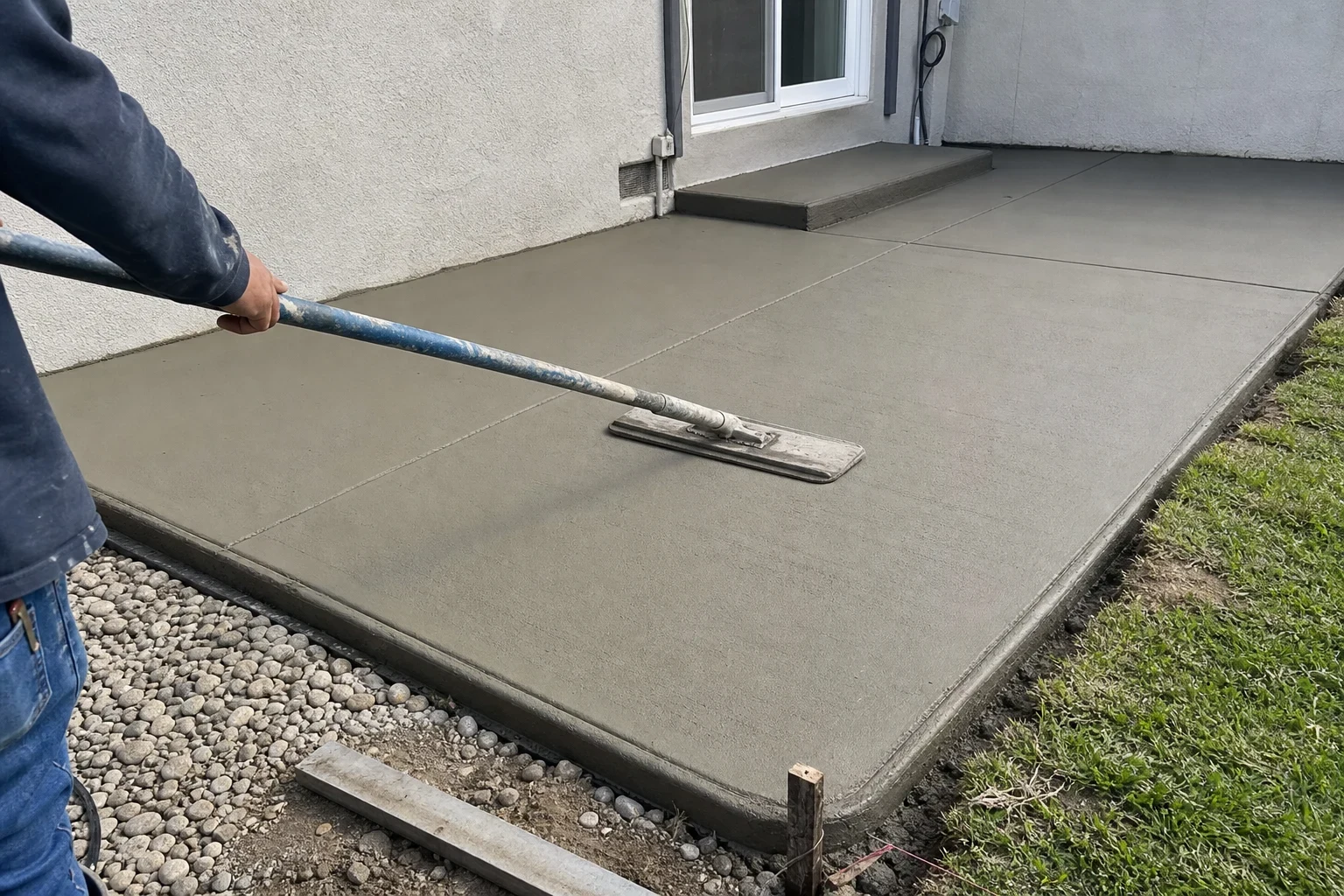
A patio built for how you use your backyard
The part of a patio that matters most is the part you never see. We shape the soil, compact a gravel base, place reinforcement and give the slab a slight fall toward the yard, so rain and sprinkler water drain off rather than collecting at your foundation. A nice surface finish only holds up when that groundwork is done properly.
Most people who call us about a patio want one of two things. Some have an old slab that's cracked, dropped or tipped back toward the house and needs replacing. Others want usable outdoor space where there's only grass or dirt today. In both cases we start by visiting, measuring and talking through size, shape, finish and how the patio meets your doors, steps and walkways.
After that you get a written estimate and a timeline built on how jobs really go, not the best possible week. A patio typically means a few working days on site plus cure time, and we lay out each day so you can plan around work, pets and weekend plans.
What your patio project includes
Removal of the old surface
Existing concrete, pavers or turf gets broken up and hauled off by our crew. The debris leaves with us instead of sitting beside your house.
Grading and base prep
We excavate to the proper depth, compact the subgrade and spread a gravel base. Parts of Orange County have clay soil that expands when wet and shrinks as it dries, which is why a firm, compacted base is worth the effort.
Forms, slope and reinforcement
Forms are set to your layout with a slight pitch built in for drainage. Before the pour, we place rebar or wire mesh to help the slab stay together for years.
Pour and finish
The concrete is placed and finished in a single visit. Pick a clean broom finish, exposed aggregate or a pattern from our Stamped Concrete options.
Control joints and curing
We cut joints so any cracking follows lines we chose rather than running across the middle. Then we show you how to keep the slab moist or covered while it cures.
Cleanup
We pull the forms, take leftover material away and hose down the paths we used to get to your backyard.
Signs it's time for a new patio
Water runs toward the house
When rain or sprinkler runoff pools at your wall or creeps under the back door, the slab has settled in the wrong direction. A new patio can be poured with the right pitch.
Wide or growing cracks
Fine hairline cracks come with concrete. A crack wide enough to slip a coin into, or one that gets longer every year, typically points to a base that has shifted.
Sunken or lifted sections
Uneven panels catch toes and leave tables rocking. The cause is usually weak compaction or roots pushing from below.
The space is too small
Plenty of older patios were built for a grill and a couple of chairs. If you need more room, a bigger slab can reach farther into the yard or wrap around the side.
Bare dirt you avoid using
A dusty or muddy spot outside the slider ends up tracked through your home. A simple concrete patio makes it space you'll actually enjoy.
How patio day and the days around it run
- 1
A visit and a written estimate
We come out to measure, check the soil and access, and hear how you want to use the space. Afterward you get a written estimate that lists each part of the job, along with a proposed schedule.
- 2
Dates you can put on the calendar
Once you say yes, we set a start date and a pour date, plus an arrival window for each crew day. If weather or a late delivery changes the plan, we let you know as soon as we do.
- 3
Demo, grading and forms
The first day or two covers tear-out, grading, base and forms. Before the pour, we walk the layout with you so the height and edges match what you expect.
- 4
Pour and finish
The concrete truck arrives inside the window we gave you, and the crew places, levels and finishes the slab the same day. Expect some noise and a few busy hours in the backyard.
- 5
Curing, cleanup and a final look together
The new slab can usually handle careful footsteps within 24 to 48 hours, and lighter furniture can go back out after about seven days. We return to pull the forms, clean up and show you how to look after the concrete as it cures.
What moves the price of a new patio
We price your patio after we've measured it and looked at the ground it will sit on, so we won't throw out a number over the phone. The written estimate breaks the job into separate lines so you can see where the money goes. These factors make the biggest difference.
- Square footage and layout
- The total area matters most. A plain rectangle forms quickly, while curves, step-downs and sharp angles add forming hours.
- How we reach the backyard
- When the truck can't get close to the pour area, the concrete travels by wheelbarrow or pump hose. A tight side yard means more labor or extra equipment.
- Tearing out an old slab
- Starting from bare dirt costs less than breaking up and hauling existing concrete. Thick or heavily reinforced slabs take more time to remove.
- Ground conditions
- Roots, soft pockets or heavy clay can call for deeper digging and extra gravel so the new patio has firm support.
- The finish on top
- A broom finish is the simplest option. Color, exposed aggregate and stamped patterns add materials and more time with the finishing crew.
Patio questions we hear often
Something not covered here? (949) 841-4109
How long until I can use my new patio?
Most slabs can take careful footsteps within 24 to 48 hours. Plan on about a week before lighter chairs and tables go back out. A hot tub, a large built-in grill or anything else heavy needs a longer wait, and we'll tell you the right number for your slab.
Will someone need to stay home while you work?
For most of the job, no. We need an unlocked gate and a clear path to the backyard, and it helps to have you there when the pour starts. You'll get an arrival window ahead of time so you can plan your day around it.
What happens if it rains on pour day?
We watch the forecast and won't pour with rain on the way. If the date has to move, we call you ahead of time with a new one, so you're never waiting at home for a crew that isn't coming.
Can you pour the patio right up against my house?
Yes. An expansion joint goes where the slab meets the wall, and the surface is pitched toward the yard so water runs away from your home. We also keep the patio below the door threshold and the weep screed along the bottom of the stucco.
Can my patio connect to a walkway or new steps?
That's often the smartest way to do it. We can plan the patio together with walkways and sidewalks or concrete steps and stairs, so the heights and finishes line up and everything runs on one schedule.
Does a patio need a permit?
A flat slab at ground level often doesn't. Adding a patio cover or building close to a property line can change that. We look at your plans during the visit and tell you plainly whether a permit is needed before any work begins.
Ready to plan your patio?
Tell us about the space and how you'd like to use it. We'll set up a visit and give you a written estimate with dates you can count on.